
Tricky!
Kepa Junkera
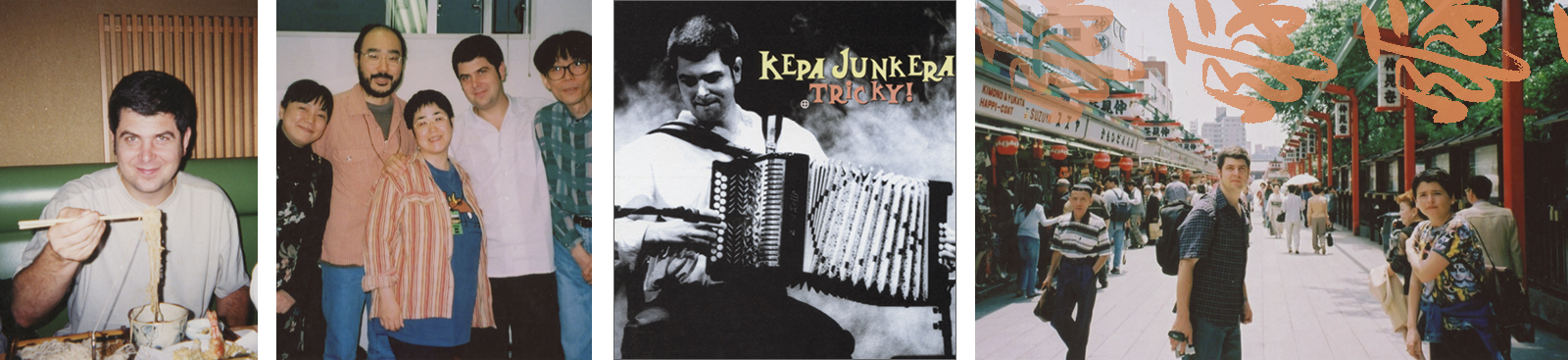
Tricky, Kepa’s first compilation album, was released exclusively in Japan through the small independent label Kaira. The album brings together highlights from his first eight records. Featuring 17 selected tracks, the project received the enthusiastic endorsement of Peter Barakan, a London-born DJ based in Tokyo since the 1970s, who became a key figure in international music in Japan and praised the opportunity to gather these pieces on an exclusive CD. For Barakan, after discovering the triki, the alboka and the txalaparta, it became impossible not to listen regularly to Kepa’s records and celebrate the release of the compilation: “Tricky!” was met with praise from the moment it appeared.
Aitor Narbaiza (KAP) recalls that the idea came from Miki Kagami, a Japanese woman fascinated by Basque culture, who attended fairs, concerts and festivals together with her husband throughout the Basque Country. She and Keiko Kawashima, from Plankton Productions, proposed introducing Kepa to Japan through a compilation album first. The title plays on the pronunciation of triki and the meaning of “tricky” (cunning or deceptive). The CD spans more than 70 minutes of the Bilbao-born musician’s career: seven tracks from his first four albums (1987–1993), four from Triki up, and ten from the 1994–1998 period, including four from the internationally acclaimed Bilbao 00:00h.
Kepa’s band — Julio Andrade, Angel Unzu, Harkaitz Martinez, Igor Otxoa and Blas Fernández — landed in Narita on 18 May 2000. Soon after, they were asked if they could share a piece with the other two invited groups, the Irish band Altan and the Romanian Taraf de Haïdouks, to which Kepa immediately agreed. Over three days they shared concerts, talks with Peter Barakan — who received many questions about the txalaparta — photo sessions and autograph signings. The final event at Hibiya Park gathered thousands of people and was recorded for radio and television. During the 15-minute collective encore, the audience climbed onto the stage to dance.
Narbaiza recalls the overwhelming success of the event and its impeccable organisation. Andrade, who had already toured Japan in 1991 with the Simón Bolívar Symphony Orchestra, remembered that 21-day journey from north to south.
The critics were equally enthusiastic: British folk specialist Andrew Cronshaw, known for his many reviews of Basque artists, described the selection as “varied and well programmed” and referred to Kepa Junkera as “an accordion genius”.
Record label: Kaiara Productions. Production: Kepa Junkera.